Aster website logo

When to Seek a Second Opinion for Ovarian Cysts in Singapore

Findings of ovarian cysts and specialist review in Singapore

Being told you have an ovarian cyst often leaves you with more questions than answers. Many women discover a cyst during a routine scan or after seeking care for pelvic pain, bloating or menstrual changes. While the finding itself is common, the advice that follows can feel confusing. One consultation may suggest watchful waiting, another may raise the possibility of surgery and the reasoning behind these recommendations is not always clear.

Most ovarian cysts are benign and do not require immediate intervention. The challenge lies in knowing which cysts can be safely monitored and which require closer attention. Decisions depend on multiple factors, including symptoms, scan findings, age and reproductive plans. When these factors are not fully explained, it is natural to feel uncertain about the path forward. This is where a second opinion becomes valuable, not as a sign of mistrust, but as a way to gain clarity and confidence in your care.

In Singapore, access to gynaecology care across both public hospitals and private specialist clinics means that seeking a second opinion is often a practical and accepted step. A review by another specialist can help confirm whether a cyst truly requires intervention, clarify areas of uncertainty or validate a conservative approach when monitoring is appropriate. For many women, this additional perspective replaces anxiety with clarity and allows decisions to be made with greater confidence. In this article, we explain when a second opinion for ovarian cysts may be helpful, what situations warrant further review and how to approach this decision within Singapore’s healthcare system.

Findings of ovarian cysts and specialist review in Singapore
A second opinion for an ovarian cyst may be helpful when symptoms persist, scan findings are unclear, treatment advice differs, or fertility and long-term health concerns need clearer guidance.

What are ovarian cysts?

Ovarian cysts are sacs filled with fluid, or sometimes thicker material, that develop in or on the ovaries. They are common, particularly in women of reproductive age and are often linked to normal hormonal changes during the menstrual cycle. Many ovarian cysts cause no symptoms and are discovered incidentally during an ultrasound performed for another reason.

It is also important to distinguish ovarian cysts from polycystic ovary syndrome (PCOS). While the name suggests cysts, PCOS is a hormonal condition characterised by irregular ovulation and metabolic features, rather than discrete ovarian cysts requiring surgical assessment. Management of PCOS often focuses on hormonal regulation and long-term health considerations, which differs from the approach taken for most ovarian cysts.

Focusing on ovarian cysts specifically, these can be broadly classified based on their origin and characteristics. Common types of ovarian cysts include:

  • Functional cysts — These are the most frequently seen ovarian cysts [1]. They form as part of the normal menstrual cycle and usually resolve on their own over a few months without treatment.
  • Endometriomas — These cysts are associated with endometriosis and may be linked to ongoing pelvic pain, painful periods or fertility concerns [2]. They persist rather than resolve spontaneously.
  • Dermoid cysts — Also known as mature cystic teratomas, these cysts develop from reproductive cells and may contain different tissue types [3]. They usually grow slowly but can cause symptoms if they become large.
  • Cystadenomas — These cysts arise from the surface of the ovary and can grow to a significant size [4]. While often benign, they may cause abdominal discomfort or pressure due to their size.

Some ovarian cysts cause symptoms such as pelvic pain, bloating or a sense of pressure, while others remain silent and are only detected on scans. This difference between symptomatic cysts and incidental findings often shapes how they are managed and explains why treatment recommendations may vary from one woman to another.
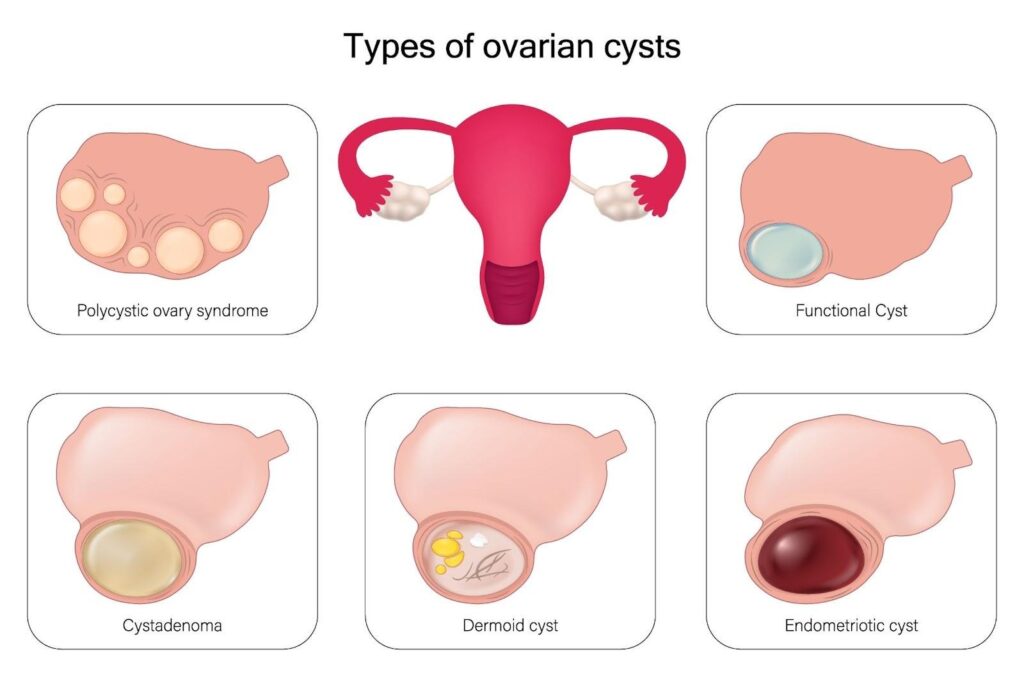
Types of Ovarian Cysts Singapore
Ovarian cysts are fluid-filled or semi-solid sacs that form on or within the ovaries and may be functional, endometriotic, dermoid or cystadenomas, with most being benign.

When are ovarian cysts usually managed without concern?

Not all ovarian cysts require treatment or urgent intervention. In many cases, a conservative approach is appropriate, especially when scan findings and symptoms suggest a low risk of complications. Careful monitoring allows doctors to track changes over time while avoiding unnecessary procedures.

Ovarian cysts are commonly managed without concern when they are:

  • Small and simple cysts found incidentally — These cysts are often discovered during routine ultrasounds and typically have smooth walls and clear fluid, with no features that raise suspicion.
  • Cysts that resolve on follow-up imaging — Many functional cysts shrink or disappear on their own over a few menstrual cycles, which can be confirmed through repeat scans.
  • Asymptomatic cysts in premenopausal women — When a cyst is not causing pain, bloating, or pressure symptoms, and imaging findings remain reassuring, observation is often sufficient.
  • Suitable for monitoring rather than immediate intervention — Regular follow-up helps ensure that any change in size or appearance is detected early while allowing time for spontaneous resolution.

For these situations, monitoring offers a balanced approach that prioritises safety while avoiding overtreatment.

Medical ways to manage ovarian cysts

Medical management may be considered for certain ovarian cysts, particularly when symptoms are mild, the cyst appears low risk on imaging, or a conservative approach is appropriate. The choice of treatment depends on the type of cyst, symptoms, and individual circumstances.

  • Hormonal medications — hormonal medications may be used in selected cases to help regulate the menstrual cycle and reduce the likelihood of new functional ovarian cysts forming. These medications do not usually shrink an existing cyst, but they may play a role in preventing recurrence in women who experience repeated functional cysts.
  • Pain relief and symptom control — when an ovarian cyst causes discomfort, medical management may focus on relieving symptoms while the cyst is monitored. This approach aims to improve the quality of life rather than treat the cyst directly.
  • Observation alongside medical management — medical treatment is often combined with follow-up scans to assess whether the ovarian cyst remains stable, reduces in size or resolves over time. Monitoring helps ensure that any change in the cyst’s appearance is detected early.
  • When medical management may not be appropriate — medical approaches are not suitable for all ovarian cysts. Cysts that are persistent, increasing in size, causing significant symptoms or showing concerning features on imaging may require further investigation or surgical consideration.

Signs that a second opinion for an ovarian cyst may be appropriate

Not all ovarian cysts require further review, but certain situations warrant a closer look. When symptoms persist, test results are unclear or management advice feels uncertain, seeking a second opinion can provide clarity if the ovarian cyst has been fully and accurately assessed.

A second opinion for an ovarian cyst may be appropriate if you experience:

  • Persistent or worsening pelvic pain — Ongoing pain that does not improve over time or that interferes with daily activities, may indicate that the ovarian cyst needs further evaluation.
  • A rapid increase in ovarian cyst size — Cysts that grow quickly between scans may require reassessment to rule out complications or alternative diagnoses.
  • Unclear or conflicting imaging findings — When ultrasound or scan reports are inconclusive or when different doctors interpret the findings differently, another review can provide clarity.
  • Symptoms affecting daily life — Bloating, pelvic pressure, urinary frequency or bowel discomfort linked to an ovarian cyst can justify a more detailed assessment.
  • An ovarian cyst detected after menopause — Cysts found after menopause often require closer scrutiny, even when symptoms are mild or absent.
  • Abnormal blood markers or inconclusive test results — Uncertain or borderline test results may benefit from further specialist input to guide appropriate next steps.

In these situations, a second opinion helps to validate the diagnosis, refine the management plan and reduce uncertainty around treatment decisions.

When ovarian cyst treatment recommendations differ or feel unclear

Advice on how to manage an ovarian cyst is not always consistent, particularly when the findings sit in a grey area. When recommendations vary or are not clearly explained, seeking a second opinion can help clarify whether the proposed approach is appropriate for your specific situation.

A second opinion may be helpful when:

  • Ovarian cyst surgery is advised without a clear explanation — Being told that surgery is necessary without a detailed discussion of why, what the risks are or whether alternatives exist can leave important questions unanswered.
  • There is uncertainty about monitoring versus intervention — When it is unclear whether an ovarian cyst should be observed with follow-up scans or treated more actively, another specialist can help weigh the risks and benefits of each option.
  • There are concerns about fertility-preserving options — For women who wish to conceive in the future, understanding how treatment choices may affect ovarian reserve or reproductive potential is essential.
  • Different views exist on conservative and surgical approaches — Variations in medical opinion can reflect differences in experience or clinical judgement and a second perspective may help determine which approach best aligns with your health needs and priorities.

Clear, well-explained guidance is central to confident decision-making, particularly when treatment options carry long-term implications.

Considering a second opinion before ovarian cyst surgery

Surgery is sometimes necessary for an ovarian cyst, but it is not always the first or only option. Before proceeding, it is important to understand why surgery has been recommended and whether alternative approaches have been fully considered. 

Before ovarian cyst surgery, a second opinion can help you understand:

  • When surgery for an ovarian cyst is recommendedSurgery is usually considered when a cyst is large, persistent, painful, growing or shows features that raise concern on imaging or blood tests [5].
  • The differences between laparoscopic and open procedures — Minimally invasive (laparoscopic) surgery often involves smaller incisions and faster recovery, while open surgery may be advised in certain situations depending on cyst size or complexity.
  • Potential risks, recovery time and long-term implications — Understanding possible complications, recovery expectations and effects on ovarian function helps set realistic expectations.
  • The importance of confirming necessity before proceeding — A second opinion can reassure you that surgery is truly needed or, in some cases, identify situations where continued monitoring may be reasonable.

When does fertility or pregnancy warrant a second opinion for an ovarian cyst?

An ovarian cyst identified during fertility planning or pregnancy often raises additional considerations beyond symptom management alone. While many cysts have little impact on reproductive outcomes, others may influence ovulation, pregnancy timing or treatment decisions, making careful assessment particularly important.

For women planning to conceive, understanding whether an ovarian cyst may affect fertility is essential. Some cysts can be safely observed, while others may warrant closer monitoring or treatment before pregnancy. When surgery is proposed, a second opinion can help clarify the potential impact on ovarian reserve and whether fertility-preserving approaches are appropriate.

During pregnancy, ovarian cysts are commonly managed conservatively, especially when they appear benign and are not causing symptoms. However, certain features, such as rapid growth or persistent pain, may require further review. Seeking a second opinion in these situations can help balance maternal safety and help avoid unnecessary intervention during pregnancy.

Concerns about cancer are often at the forefront when an ovarian cyst is identified, even though the majority of ovarian cysts are benign. Certain features, however, may prompt closer evaluation to ensure that risk is appropriately assessed and explained.

A second opinion may be helpful when imaging shows features that are less clearly benign, such as solid areas, irregular borders or changes in size over time. In these situations, further specialist review can help clarify whether these findings warrant additional investigation or continued monitoring.

Blood tests and imaging are often used together to assess risk, but results are not always definitive. When tumour markers are borderline or scan findings are inconclusive, a second opinion can help place these results in context and reduce uncertainty around their significance.

Importantly, seeking a second opinion is not only about identifying potential risk, but also about reassurance. For many women, confirmation that a cyst appears low-risk provides peace of mind and avoids unnecessary anxiety. At the same time, it ensures that concerning signs are not overlooked and that follow-up is appropriate for the individual’s overall clinical picture.

What to expect during a second opinion consultation in Singapore

A second opinion consultation is usually focused on gaining clarity rather than repeating the entire diagnostic process. The aim is to review existing information carefully, address uncertainties and discuss whether the current management plan is appropriate for your situation. You can expect:

  • A review of scans, reports and medical history to understand the type of ovarian cyst, associated symptoms and previous recommendations.
  • Possible repeat imaging or tests if existing results are unclear or insufficient for confident assessment.
  • A discussion of alternative management plans, including monitoring, medical management or surgical options where relevant.
  • Coordinated care between specialists when input from radiologists, fertility specialists or gynaecological oncologists is required.

This structured approach helps ensure that decisions are based on a complete and well-understood clinical picture.

What questions should I ask when seeking a second opinion for an ovarian cyst?

Once you have decided to seek a second opinion, knowing what to ask can make the consultation more meaningful and help you leave with a clearer understanding of your situation. The aim is not only to confirm a diagnosis, but also to understand your options, potential risks and what to expect moving forward. Asking the right questions can help ensure that recommendations are tailored to your symptoms, health priorities and future plans.

Important questions to discuss with your gynaecologist include:

  • What type of ovarian cyst do I have, and what features on imaging support this diagnosis?
  • Is this ovarian cyst likely to resolve on its own, or does it require active treatment?
  • Is monitoring an appropriate option, and how often should follow-up scans be performed?
  • What are the potential risks of waiting versus treating the ovarian cyst now?
  • Are there medical or non-surgical options that may be suitable in my case?
  • If surgery is being considered, what are the reasons it is recommended?
  • What type of surgery would be advised, and are fertility-preserving approaches possible?
  • How might this ovarian cyst or its treatment affect fertility, hormones or future pregnancy plans?
  • What symptoms should prompt earlier review or urgent medical attention?
  • What follow-up care will be required after diagnosis or treatment, and how will this be monitored over time?
  • What should I expect in terms of recovery, including timeline and activity restrictions, if treatment is needed?

These questions help guide a structured discussion and support informed decision-making, so you can move forward with greater confidence and clarity.

Conclusion

An ovarian cyst diagnosis is often unsettling, not because it always signals serious illness, but because decisions about monitoring, treatment and follow-up are not always straightforward. While many ovarian cysts are benign and resolve without intervention, uncertainty can arise when symptoms persist, scan findings are unclear or recommendations differ.

Seeking a second opinion provides an opportunity to clarify these uncertainties. It allows findings to be reviewed in context, management options to be explained more fully, and individual priorities such as fertility, pregnancy or long-term health to be considered. In many cases, a second opinion confirms that conservative management is appropriate; in others, it helps identify when further investigation or treatment is genuinely needed.

In summary, it is not about questioning medical advice, but about gaining reassurance and understanding when important health decisions are involved. For many women, this process brings clarity and confidence, helping them move forward with decisions that feel informed, balanced and right for their circumstances.

References 

  1. Raja, P., & Suresh, P. (2024). Variety of ovarian cysts detection and classification using 2D Convolutional Neural Network. Multimedia Tools and Applications, 83(16), 49473–49491. https://doi.org/10.1007/s11042-023-17439-7 
  2. Kheil, M. H., Sharara, F. I., Ayoubi, J. M., Rahman, S., & Moawad, G. (2022). Endometrioma and assisted reproductive technology: A review. Journal of Assisted Reproduction and Genetics, 39(2), 283–290. https://doi.org/10.1007/s10815-022-02403-5 
  3. Birbas, E., Kanavos, T., Gkrozou, F., Skentou, C., Daniilidis, A., & Vatopoulou, A. (2023). Ovarian masses in children and adolescents: A review of the literature with emphasis on the diagnostic approach. Children (Basel, Switzerland), 10(7), 1114. https://doi.org/10.3390/children10071114 
  4. Ning, K., Salamone, A., Manos, L., Lafaro, K. J., & Afghani, E. (2023). Serous cystadenoma: A review on diagnosis and management. Journal of Clinical Medicine, 12(23), 7306. https://doi.org/10.3390/jcm12237306 
  5. Mobeen, S., & Apostol, R. (2025). Ovarian cyst. In StatPearls. StatPearls Publishing. http://www.ncbi.nlm.nih.gov/books/NBK560541/ 

Related Blogs

When to Seek a Second Opinion for Ovarian Cysts in Singapore

Being told you have an ovarian cyst often leaves you with more questions than […]

Read More
Silent Symptoms of Endometriosis: What Most Women Dismiss as Normal Pain

Chronic bloating. Lower back pain. Fatigue that lingers even after rest. These are symptoms […]

Read More
PCOS Myths vs. Facts: What Every Woman Needs to Know 

Many women live with Polycystic Ovary Syndrome (PCOS) without realising fact from fiction. This […]

Read More

Dr. Ng Kai Lyn

MBBS (SG) | MMed (SG) | MRCOG (UK) | FAMS (SG)

Empowering Women's Health

This article has been medically reviewed by Dr Ng Kai Lyn
Dr Ng Kai Lyn 黄楷伶 is a Consultant Obstetrician and Gynaecologist with sub-specialty expertise in urogynaecology and minimally invasive surgery, as well as a clinical interest in fertility.
(65) 9152 4942
(65) 6635 2100
[email protected]

Let’s Talk to Dr. Ng Kai Lyn 黄楷伶

    I understand enquiries about medical conditions cannot be addressed without an in-person consultation with a healthcare professional and should not be submitted through this form.

    The contents on this website provides general information only and does not replace professional or specialist advice. If you think you may have any medical condition, always seek prompt medical attention from a professional healthcare provider. It is not advisable to delay consulting professional advice by relying on the information provided here. Although reasonable efforts have been made to ensure that the information is relevant and comprehensive, we make no guarantees or representation that the contents on this website are complete, up-to-date or accurate. drngkailyn.com is independently owned and is not affiliated or endorsed by any organisation.
    Aster website logo

    Aster Gynaecology © | All Rights Reserved.

    map-markerclockcrossmenuchevron-down