


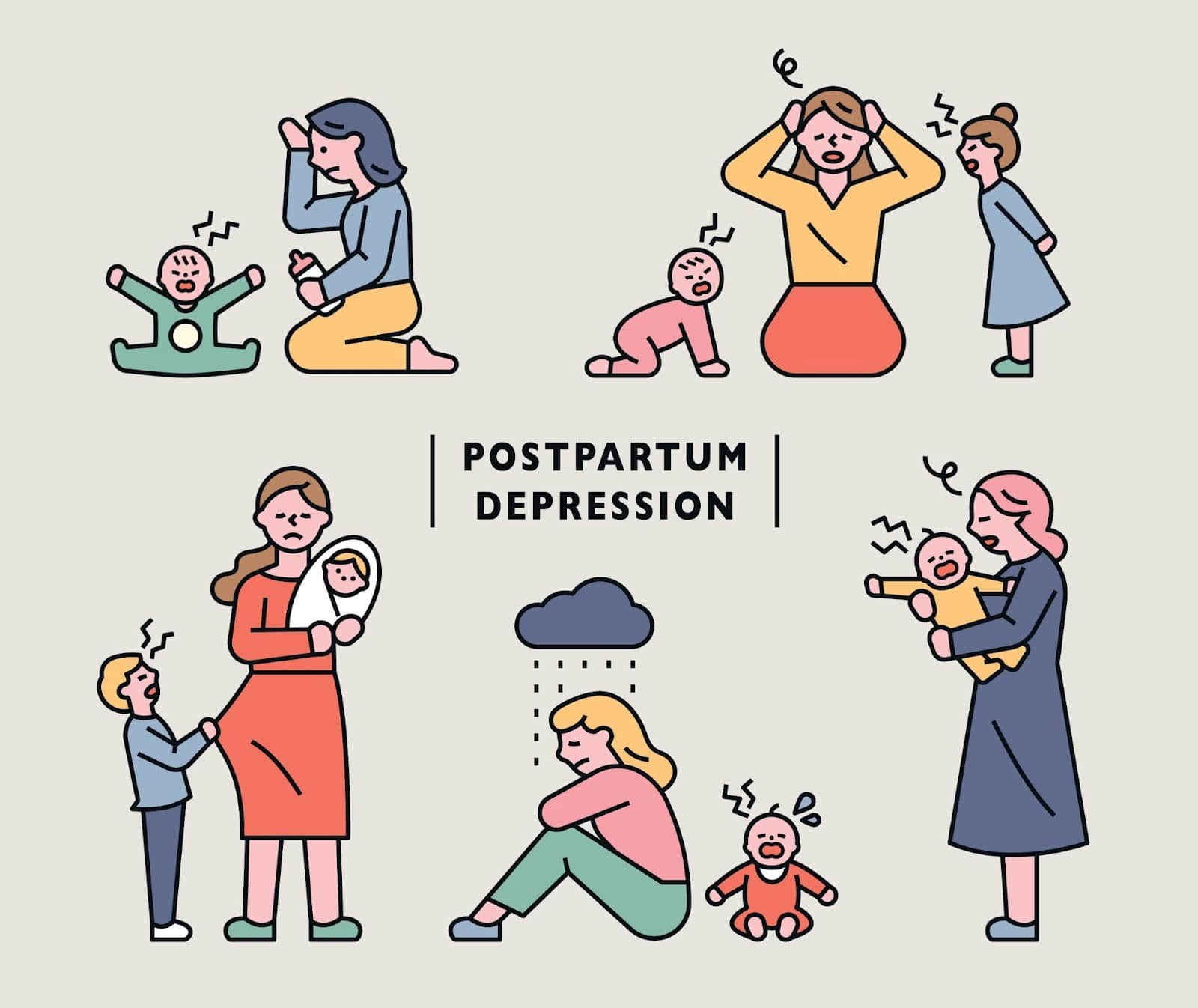
According to the American Psychiatric Association, up to 1 in 7 women may experience postpartum depression; unlike baby blues, it doesn’t usually go away on its own without treatment.
Baby blues can be common (up to 70% of all new mothers) and usually manifest in women feeling a little down, tearful or anxious in the first 1-2 weeks of giving birth; these symptoms typically resolve on their own, and usually do not interfere with your ability to carry out daily activities.
If symptoms start later or last longer, there is a possibility that you may be having postpartum depression rather than a simple case of baby blues. Women with PPD may face significant impedance and difficulty in going about their daily lives.
Symptoms of postpartum depression vary between individuals but can include one or more of the following:
If the fore-mentioned symptoms are severe or last longer than 2 weeks, you should seek help. Remember, seeking help is NOT a sign of weakness – it is not your fault and you should not perceive yourself as a bad parent.
Postpartum psychosis is rare, occuring in 1-2 every 1000 deliveries[1], but extremely serious, requiring immediate medical attention.
Symptoms of postpartum psychosis are more extreme than depression and may include:
In some cases, women with postpartum psychosis may have a personal or family background of bipolar disorder or schizophrenia, or may have developed it following a previous pregnancy.
PPD can appear days or months after childbirth, and can last for weeks, months or more if untreated.
Although PPD can affect any woman, there are some women who can be at increased risk of developing PPD. These include:
Yes, postpartum depression is curable with proper treatment. It is important to seek treatment as children of mothers with postpartum depression who are untreated are at greater risk of cognitive, emotional, developmental deficits and impaired social skills[2].
The first line therapy for PPD generally includes psychotherapy if the depression is mild; if the depression or anxiety is severe, medications are usually required – these should be instituted together with lifestyle modifications within a supportive social network.
Support groups, exercise, carving out time for yourself and eating healthily can also go a long way in helping you overcome postpartum depression.
If you suspect that you may be suffering from postpartum depression, you should contact any medical professional – be it your ObGyn, your general practitioner or a therapist to seek help early. Prompt assessment is important and referrals can then be made to a psychologist, psychiatrist or mental health professional. Remember – you are not alone!
There is no proven way to prevent PPD – even women who had smooth sailing pregnancies and deliveries with great social support networks can develop PPD. With greater awareness, however, you and your partner can be on the lookout to ensure early recognition of the symptoms of PPD so that prompt help and treatment can be sought.
References
This is a personal decision. You can choose to either breastfeed or bottle-feed exclusively, or a combination of both at different proportion or times. It is entirely up to you, and there is no right or wrong answer.
Breast milk has many advantages. If you choose to breastfeed exclusively, it is recommended to do so for the first 6 months of baby’s life and beyond for as long as you and your baby are comfortable with.
For baby:
For you:
Start within the first hour of birth
Skin-to-skin contact where you hold your baby against your bare skin right after birth encourages the start of breastfeeding. Try to room in with your baby as it will allow you to breastfeed easily.
Latch on
Cup your breast in your hand and stroke your baby’s lower lip with your nipple. Your baby will open his/her mouth – bring your baby close to your breast and aim your nipple towards the roof of your baby’s mouth.
The first breast milk you will produce is colostrum, which is yellow in colour and contains all the good stuff including proteins, carbohydrates, vitamins, minerals and antibodies. Over the next 2 weeks you will find that this slowly changes to mature breast milk.
Hungry babies usually look alert, bend their arms, close their fists, and bring their fingers or fists to their mouths. Offer your baby your breast when he/she starts bringing fingers to his/her mouth. Crying is a late sign of hunger and an unhappy baby will be difficult to soothe. When full, babies relax and close their eyes.
Breastfeed often
Breastfeed on demand – this will mean feeding at least 8-12 times in 24 hours, or at least every 2-3 hours. Many babies breastfeed for 10-15 minutes on each breast, sometimes longer. When your baby releases one breast, offer the other. If your baby is not interested, start on this other breast for the next feed.
Troubleshoot breastfeeding
Nobody starts off as an expert in breastfeeding – it is something that takes time to learn even if you have the necessary equipment. Do not be discouraged or take it personally! Help is readily available from lactation consultants, and there is no shame in asking for help. Don’t beat yourself up about it and try not to become too anxious.
You will need 450-500 extra calories to make breast milk for your baby. Keep well hydrated. Continue to take your prenatal multivitamins and calcium tablets while you are breastfeeding. Eat fish and seafood 2-3 times a week but avoid fish with high mercury levels e.g. swordfish, mackerel, tilefish, albacore tuna. Avoid caffeine especially in the beginning or if your baby is premature. If you take alcohol, wait for at least 2 hours after drinking before breastfeeding. Avoid smoking. If you prescribed medications, let your doctor know that you are breastfeeding.
Exclusive breastfeeding can technically act as birth control for the first 6 months, but it is not 100% protection. If you are doing mixed or combination feeding, your fertility will return earlier (maybe even before your periods resume).
Depending on the interval from your childbirth, many birth control methods can be used, including birth control pills, implanon, intrauterine contraceptive device (IUD) etc. Your gynaecologist will be able to discuss these with you.
Episiotomy/vaginal tear
You may have had a cut in the vagina to help with childbirth – even if you didn’t, having a baby come out through your vagina is bound to make you feel sore down below. You may find sitting on doughnut cushions and doing regular warm salt baths helpful. Change your pads regularly and keep yourself clean and dry. Read more about episiotomy care here.
Piles
All that weight you were carrying around during pregnancy and force exerted during childbirth can result in you having piles. Avoid constipation by keeping hydrated and taking lots of fruits and vegetables. Your gynaecologist can prescribe you stool softeners so that you don’t strain as well as ointments for your piles.
Uterine contractions
You will still feel contraction-like cramps in the weeks after you deliver, especially after breastfeeding. This is because your uterus is slowly getting back to its pre-pregnancy size.
Lochia
It is normal to have significant bleeding during and after childbirth, which should reduce over time and stop in about 4-6 weeks. If you experience bleeding that gets heavier, fever or foul-smelling discharge, you should see your gynaecologist earlier.
Anaemia
Your blood count may be low after all that bleeding from your childbirth – do eat a healthy diet with lots of iron and vitamin C, and continue with your prenatal vitamins.
Breast engorgement and nipple pain
You may begin to feel this a few days after giving birth. Breastfeed your newborn on demand and use a breast pump if necessary. Putting cold packs on your breasts can help. Cracked nipples can be a sign of improper latch on so check with your lactation consultant. You may massage some breast milk on your nipples after breastfeeding or apply some nipple cream that your gynaecologist can prescribe.
Stretch marks
Stretch marks that have appeared in your pregnancy may fade after childbirth but will unlikely disappear completely. Keep your skin moisturized and speak to your gynaecologist or dermatologist for options to treat stretch marks.
Hair loss
You will experience hair thinning or hair loss in the weeks and months after you give birth – this is because of hormonal changes that your body goes through after delivery and may last up to half a year. Expect to wait about a year before your hair goes back its normal fullness.
Weight
Although you will want to aim to get back to your pre-pregnancy weight as soon as possible, don’t lose all that weight in too short a time as that can affect your breast milk supply. Start by staying active (check with your gynaecologist when is an appropriate time to start gentle exercises, especially if you have had a C-section) and keeping to a healthy diet. Breastfeeding helps as well. Don’t be too hard on your body as you will take time to tone back up – it just performed an amazing miracle!
Urinary incontinence
Your pelvic floor muscles are weakened from all that weight you were carrying throughout pregnancy and the stress during childbirth – it can be quite common to experience urinary leakage when you don’t want to and feel like your bladder is beyond your control. Do your Kegel (pelvic floor) exercises regularly and your bladder function will likely return over time.
Baby blues and postpartum depression
Feeling sad and down after you’ve had your baby is common – nobody starts off as an expert in mothering. These feelings are normal and will typically go away in a few weeks. Do get help and support from your partner and family. Postpartum depression, however, usually consists of strong feelings of helplessness, sadness, anxiety and tiredness that are persistent and interfere with your ability to care for yourself and your baby – this can be serious and you should shy away from speaking to your gynaecologist about it.
Sex
Although there is no fixed timeframe, it is generally recommended that you wait at least 4-6 weeks before resuming sex, especially if you have had episiotomy/vaginal tears or a C-section. The first few times might feel awkward and different – open communication with your partner is important. Do your Kegels, take it slow, make time for sex, engage in plenty of foreplay and use lubrication.
It is normal to have significant bleeding during and after childbirth, which should reduce over time and stop in about 4-6 weeks. Postpartum haemorrhage is when you have heavy bleeding of 500ml or more after birth. If this happens in the first 24 hours after childbirth, it is considered primary PPH. If this occurs between 24 hours and 12 weeks after childbirth, it is considered secondary PPH.
Many women who experience heavy bleeding after birth do not have risk factors, and vice versa. Some of the risk factors include:
You may feel faint or giddy. Heavy bleeding after birth can happen quickly and is considered an emergency as it may turn potentially life-threatening, so you may have people rushing into your room.
You will need intravenous plugs to draw bloods for tests and to run fluids through a drip. Your temperature, blood pressure, pulse rate and oxygen levels will be monitored closely. Your gynaecologist will check the size and tone of your uterus through your abdomen and vagina, your episiotomy/ vaginal tears, and your placenta to ensure that you do not have any retained placenta bits.
Depending on your condition, you may require:
You may need monitoring in a high-dependency or intensive care unit until you stabilise, after which you will be allowed to eat, drink, move about and breastfeed.
After your bleeding and blood counts stabilise, you will be given either intravenous or oral iron supplements as you will still be anaemic and may feel tired. Your blood count may take 6 weeks or longer to go back to normal levels.
You may experience:
Your gynaecologist will need to take a detailed history and do a pelvic examination. As secondary PPH is usually related to infection or retained placenta bits in your uterus, vaginal swabs will be sent to check for infection, and an ultrasound scan performed to check the thickness of your uterine lining. You may need blood tests.
You will require intravenous antibiotics (this will be changed to oral once you improve). If there is suspicion of retained placenta bits, you will need to undergo a surgical evacuation to wash out the contents inside your uterus.
You do have an increased risk of having PPH in your subsequent deliveries. You should speak to your gynaecologist about it and take oral iron supplements during your pregnancy to ensure your blood count is good and you are not anaemic.
Family planning and pregnancy spacing play a role in determining how close (or far apart) your children will be in terms of age gap. This is a personal decision that should be made by you and your partner as many factors are involved.
The American College of Obstetricians and Gynecologists recommends waiting 18 months before attempting your next pregnancy. For older women, however, this gap may be shortened to a year taking into account fertility concerns.
This applies to women who underwent childbirth and not for women who had a miscarriage – for the latter, you may resume attempting pregnancy as soon as you and your partner feel ready.
You may not have had enough time to recover from your previous pregnancy before embarking on your next one. If your gap is 6 months or less, your risks may include:
Yes, it is safe for you to continue breastfeeding while pregnant. However, it may trigger mild contractions, so if you are at risk of premature labour, you should speak to your gynaecologist for advice.
You will likely produce less milk and your milk content may change as your current pregnancy progresses – this may mean that your older child may wean themselves, or put on less weight if your child is on exclusive breastfeeding. You may need to watch closely for this.
This will be tiring for you, so make sure you take care of yourself by exercising, eating healthily and getting lots of rest and support.
Reliable birth control methods can help you do this – click here for more information.




Aster Gynaecology © | All Rights Reserved.
