Aster website logo

Hysteroscopy

hysteroscopy

What is a hysteroscopy?

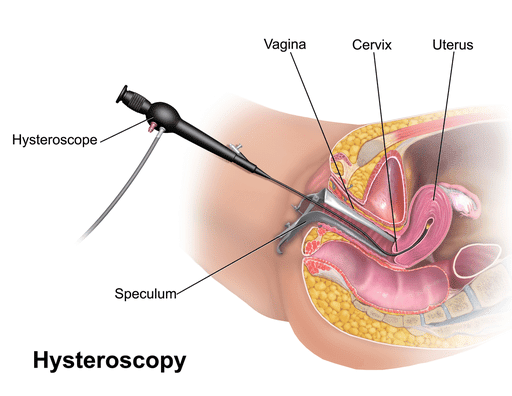
A hysteroscopy involves the insertion of a telescope camera through the cervix (neck of womb) into the uterus, with fluid instilled inside the uterus to open up the uterine cavity. This allows diagnosis (and in some cases, treatment) of abnormalities of the uterine cavity and lining. 

Hysteroscopy is frequently performed to achieve a diagnosis when the following gynaecological conditions are suspected:

  • Endometrial polyps
  • Submucous uterine fibroids
  • Abnormal shapes of uterine cavity e.g. septate or bicornuate uterus 
  • Asherman’s syndrome (scar tissue involving uterine cavity)
  • Infertility/ recurrent miscarriages
  • Difficulty in cannulating the uterus (e.g. for fertility treatments)

Hysteroscopy can also be used to treat some of the above conditions when combined with other procedures such as polypectomy (removal of endometrial polyps), excision of fibroids/septum, division of scar tissue, dilation and curettage etc. 

Hysteroscopy is generally a safe and commonly done procedure. 

Risks of hysteroscopy include:

Common risks:

  • Vaginal bleeding and discharge – this may last up to 1-2 weeks 
  • Pelvic discomfort or pain 

Uncommon but potential serious risks:

  • Pelvic infection
  • Failure to visualise the uterine cavity
  • Asherman’s syndrome
  • Uterine perforation (<1%): this may require a laparoscopy (keyhole) or laparotomy (open) for repair and to check for injury to bowels/bladder/blood vessels
  • Failure to complete intended procedure (e.g. if polyp/fibroid/septum is large)
  • Fluid overload 
  • Anaesthetic complications

Photo credit: BruceBlaus / Wikimedia Commons

Related Blogs

Silent Symptoms of Endometriosis: What Most Women Dismiss as Normal Pain

Chronic bloating. Lower back pain. Fatigue that lingers even after rest. These are symptoms […]

Read More
PCOS Myths vs. Facts: What Every Woman Needs to Know 

Many women live with Polycystic Ovary Syndrome (PCOS) without realising fact from fiction. This […]

Read More
Fibroids vs. Cysts: What’s the Difference?

Within the realm of women’s health, the terms “fibroids” and “cysts” are often mentioned […]

Read More

Dr. Ng Kai Lyn

MBBS (SG) | MMed (SG) | MRCOG (UK) | FAMS (SG)

Empowering Women's Health

This article has been medically reviewed by Dr Ng Kai Lyn
Dr Ng Kai Lyn 黄楷伶 is a Consultant Obstetrician and Gynaecologist with sub-specialty expertise in urogynaecology and minimally invasive surgery, as well as a clinical interest in fertility.
(65) 9152 4942
(65) 6635 2100
[email protected]

Let’s Talk to Dr. Ng Kai Lyn 黄楷伶

    I understand enquiries about medical conditions cannot be addressed without an in-person consultation with a healthcare professional and should not be submitted through this form.

    The contents on this website provides general information only and does not replace professional or specialist advice. If you think you may have any medical condition, always seek prompt medical attention from a professional healthcare provider. It is not advisable to delay consulting professional advice by relying on the information provided here. Although reasonable efforts have been made to ensure that the information is relevant and comprehensive, we make no guarantees or representation that the contents on this website are complete, up-to-date or accurate. drngkailyn.com is independently owned and is not affiliated or endorsed by any organisation.
    Aster website logo

    Aster Gynaecology © | All Rights Reserved.

    map-markerclockcrossmenuchevron-down