


In this article, we’ll discuss:
Cervical cancer is cancer arising from the neck of the womb. The National University Cancer Institute Singapore (NCIS) ranks cervical cancer in the top 10 cancers affecting Singaporean women in their latest trends for 2011 – 2015, with it currently in the 10th position.
Cervical cancer does not happen overnight – there is typically a slow progression over years before cancer finally occurs. The most common starting point is abnormal changes of the cells of the cervix, called CIN, or cervical intra-epithelial neoplasia.
CIN is in turn classified into:
As CIN does not cause any symptoms, the most common way it is detected is via a Pap smear screening, where abnormalities are first picked up, followed by a colposcopy assessment and cervical biopsy.
In recent times though, researchers have shown that the reason why CIN occurs is due to persistent infection with certain types of human papillomavirus (HPV); as such, HPV is now the focus of screening and prevention when it comes to cervical cancer.
The World Health Organisation[1] points out that a vast majority of cervical cancers (more than 95%) is linked to HPV.
HPV is a common viral infection that will infect most sexually active people in their lifetimes. According to the Centers for Disease Control and Prevention[2] (CDC), more than 200 distinct HPV types have been identified and they are classified into:
Note: Infection with a high risk HPV type does not necessarily mean that you will develop cervical cancer.
In actual fact, most women with a normal immune system (over 90%) can and will clear the viral infection by themselves with no sequelae – it is only in the case of persistent infection with a high-risk HPV type where problems arise.
Women with a suppressed immune system, e.g. with human immunodeficiency virus (HIV), solid organ transplants, heavy smokers etc are at an increased risk of developing cervical cancer.
Other than causing cervical cancer, high risk HPV infection can also cause cancers of the vulva, vagina, anus, penis and oropharyngeal cancers.
3 different HPV vaccinations are now available, namely Cervarix, Gardasil-4 and Gardasil-9, with Gardasil-9 being the latest released in the market.
| Cervarix | Gardasil-4 | Gardasil-9 |
|---|---|---|
| Protects against HPV types 16 and 18 (both high-risk cancer causing types that cause 70% of cervical cancers) | Protects against HPV types 16 and 18 as well as low-risk non cancer causing types 6 and 11 (which cause 90% of genital warts) | Has the same coverage as Gardasil-4 and provides additional coverage against 5 more high-risk cancers causing types 31, 33, 45, 52 and 58, which all in all cause 90% of cervical cancers. |
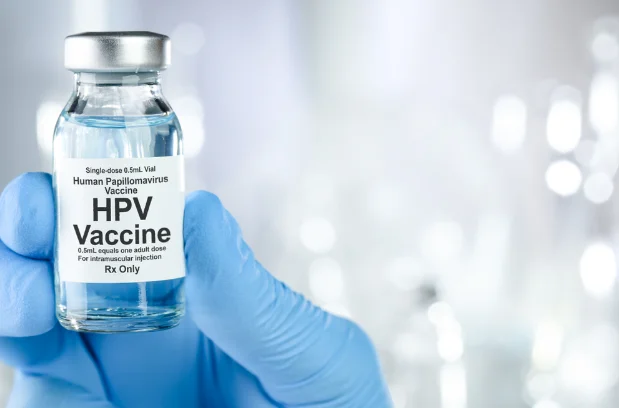
Under the National School-based HPV programme, the Health Promotion Board offers subsidized Cervarix vaccinations to eligible Secondary 1 and 2 female students attending MOE-registered schools, Special Education schools, privately funded Schools and full-time Madrasahs:
However, HPV vaccination is not compulsory and requires parental consent in order to proceed.
Medisave can be used to subsidize the cost of Cervarix and Gardasil-4 vaccinations in eligible individuals 26 years and below in Singapore, but does not cover Gardasil-9. It is important to note, though, that Gardasil-4 has since been discontinued in Singapore from July 2022.
For those above 26 years old who have not been vaccinated, there is no need to despair.
The Food and Drug Administration (FDA) has approved Gardasil-9 for use in women and men through to age 45 years – that’s right, men can and should be vaccinated too!
The ACIP (Advisory Committee on Immunization Practices) recommends that HPV vaccination be based on shared clinical[3] decision making for individuals aged 27 through 45 years though, so you should discuss with your gynaecologist about the pros and cons about getting vaccinated before proceeding with it so that you can make an informed decision.
The National Cervical Cancer Screening Programme in Singapore advocates the following:
The reason why younger females aged 25 to 29 years old are encouraged to go for a Pap smear test rather than a HPV test is due to the high prevalence of HPV infection in this age group, which can lead to unnecessary panic and further invasive tests which may not be necessary given most women will clear these infections on their own.
The HPV test is performed the same way as a Pap smear test:
Note: Being HPV vaccinated does not mean that you have 100% protection against cervical cancer – you should still continue with your regular cervical cancer screening. This is to ensure that any pre-cancerous changes can be picked up early – CIN is easily treatable, to arrest the progression to cervical cancer.
It is hoped that as more women get the HPV vaccine and glean a greater awareness of the need for regular screening, cervical cancer gradually becomes a thing of the past.
A recent publication by the Lancet[4] in December 2021 showed a substantial reduction of cervical cancer and CIN3 in young women since the introduction of HPV immunization programme in England, with the programme successful in almost eliminating cervical cancer in women born since 1st September 1995. This is heartening news indeed and one can certainly hope that Singapore will reach the same target soon.
Do you have any questions for me? Feel free to contact me and I’ll reply as soon as I can.
References
Most women experience irregular periods at the start and towards the end of their reproductive lifespan; some women continue to have irregular periods throughout the majority of their menstruating lives.
But what constitutes the definition of irregular periods? The interval between periods should be counted from the first day of one period to the first day of the next period to ensure consistency.
Contrary to what most people think, a regular period does not necessarily have to be 28 or 30 days apart.
In this article, we’ll discuss:
A normal interval between periods can be anywhere from 21 to 35 days – it varies between each individual woman and the most important thing is to know what is normal for yourself.
If you have a background of regular periods and have just encountered one episode of irregular periods i.e. your period suddenly came too early or too late, ensure that it is not pregnancy-related; if it is not, there is generally no need to panic and rush to your gynaecologist’s office.
It is worthwhile to:
PCOS is short form for polycystic ovary syndrome, which is a common gynaecological condition afflicting many women of reproductive age. The Centers for Disease Control and Prevention (CDC) estimates that 6-12%[1] or as many as 5 million US women of reproductive age have PCOS, which is one of the most common causes of female infertility.
PCOS is diagnosed based on the Rotterdam[2] criteria, where one needs to fulfil at least 2 out of 3 diagnostic criteria:
Note: Having one of the above does not necessarily mean that you have PCOS.
You need 2 out of 3 criteria at least; you will generally need to see a gynaecologist who will be able to take a detailed medical history, perform a physical examination as well as investigations such as pelvic ultrasound and blood tests to determine the likelihood of you having PCOS.
Although the exact cause of PCOS remains unknown, there seems to be a genetic predisposition to it. For example, if your mother had a history of PCOS, you may be at increased risk of having PCOS yourself.
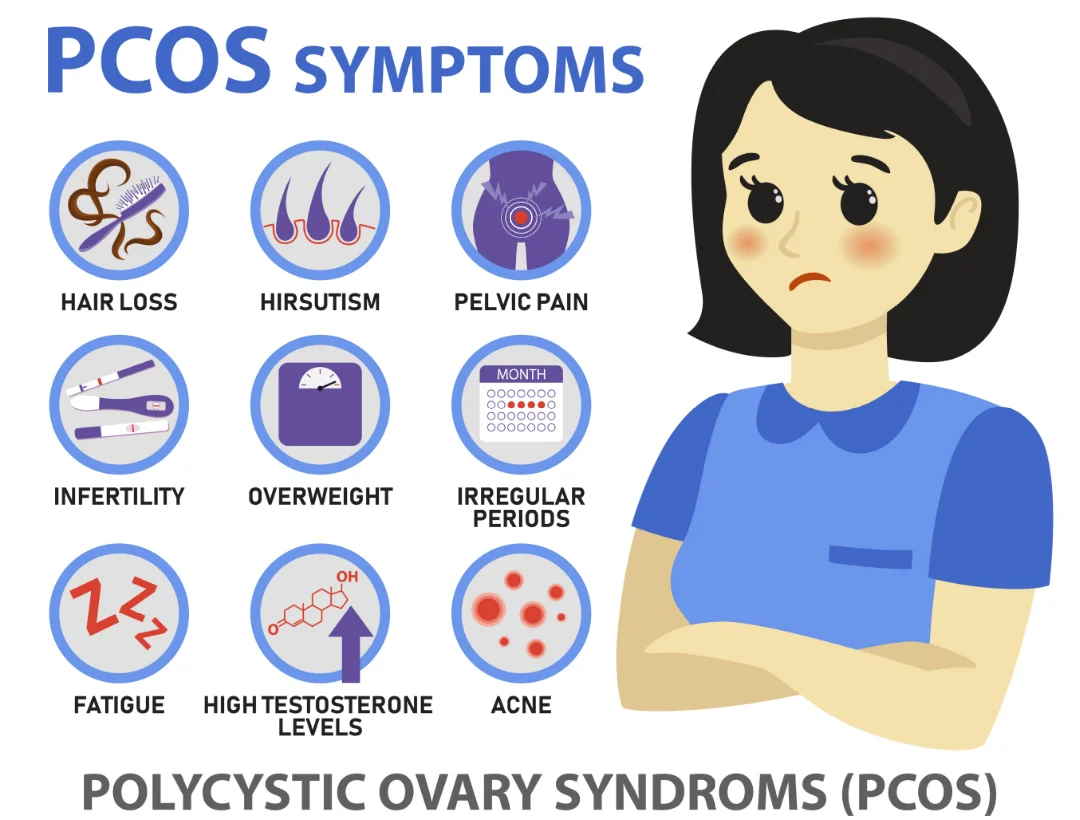
Not every woman with PCOS will manifest with symptoms. Symptoms of PCOS include:
As such, women with PCOS can be at an increased risk of developing other health problems such as:
Although some women with PCOS continue to have regular periods every month, women with PCOS tend to have irregular periods due to hormonal imbalances in their body.
High levels of androgens and insulin resistance disrupt the process of ovulation, where a mature egg is released from the ovary every month. This in turn disrupts the physiological cycle of menstruation, resulting in irregular periods or even absent periods.
It is not uncommon for women with PCOS to either have periods only once every few months, or not at all unless they take medications from the doctor’s office to induce their periods.
As PCOS has important implications on your fertility and can put you at a greater risk of developing long-term health problems highlighted above, it is essential to seek help and obtain an early diagnosis if you suspect you may be having PCOS.
Treatment for PCOS include the following:
Do you have any questions for me? Feel free to contact me and I’ll reply as soon as I can.
References
HPV is short form for human papillomavirus, which is a common viral infection that will infect most people in their lifetimes. It is transmitted through intimate contact and is extremely common in people who have had sex before.
HPV infection does not usually manifest in any systems, and like Covid-19, has many different strains.
“Low risk” HPV are non cancer-causing and typically cause genital warts.
“High risk” HPV can result in pre-cancerous changes in cervical cells which may eventually lead to cervical cancer if persistent and left untreated. Other gynaecological cancers associated with HPV infection include vaginal and vulval cancers in women, and penile cancers in men. Types 16 and 18 are high-risk types that are known to cause about 70% of cervical cancers, whilst types 6 and 11 are low-risk types that usually cause non cancerous genital warts.
HPV vaccines work by preventing infection by certain types of HPV. The vaccine is based on virus-like particles (VLPs) that are formed by HPV surface components, and does not contain any live or killed virus – hence there is no chance that the HPV vaccine can cause cervical cancer nor any HPV-related diseases.
HPV vaccine protects against certain strains of HPV, and has been shown to be highly effective in its protection against cervical cancer – a study published in the Lancet[1] showed that the HPV immunization programme in England resulted in a substantial reduction in cervical cancer and incidence of CIN3 (severe pre-cancerous changes) in young women, with near complete elimination of cervical cancer in women born since 1st September 1995.
The HPV vaccine is a safe vaccine with minimal side effects. The most common side effects are pain, swelling/redness at the injection site, and temporary headache.
| Type | Details |
| Cervarix |
|
| Gardasil-9 |
|
HPV vaccine is best administered between ages 9 to 26 years old but is licensed up to 45 years of age, and can be given to both girls and boys. It is best given before one’s sexual debut, and is a 2-dose regime for girls/boys aged 9 to 14 years, and a 3-dose regime for girls/boys aged 15 years and above.
The immunity has been shown to be long-lasting, and there is no current evidence that booster shots are required. It is important to note, however, that protection is not 100% even if you are fully vaccinated and hence it is still recommended that you have regular cervical cancer screening.
Deciding which HPV vaccine to get is an individual choice, but if you are looking for the most comprehensive coverage, then it is advisable to go for the Gardasil-9 vaccine. Remember, ultimately getting vaccinated is better than being completely unvaccinated.
Yes, you can still take the HPV vaccine after 26 years of age, and even after you have started having sex. Although HPV vaccination in this case provides less benefits as you may already have been exposed to HPV, it does give some level of protection compared to not getting vaccinated at all.
You need to know that getting the vaccine won’t cure HPV if you already have it. However, even if you are infected with 1 strain, the vaccine will serve to protect you against other strains.
In that light, the US Food and Drug Administration[2] announced in 2018 that it had expanded the approved age for HPV vaccine up to 45 years old for both men and women. It is worthwhile discussing with your doctor if you are considering getting the HPV vaccine after 26 years of age, to understand the pros and cons of the vaccine.
References




Aster Gynaecology © | All Rights Reserved.
